 ChatGPT
 Perplexity
 Claude
 Gemini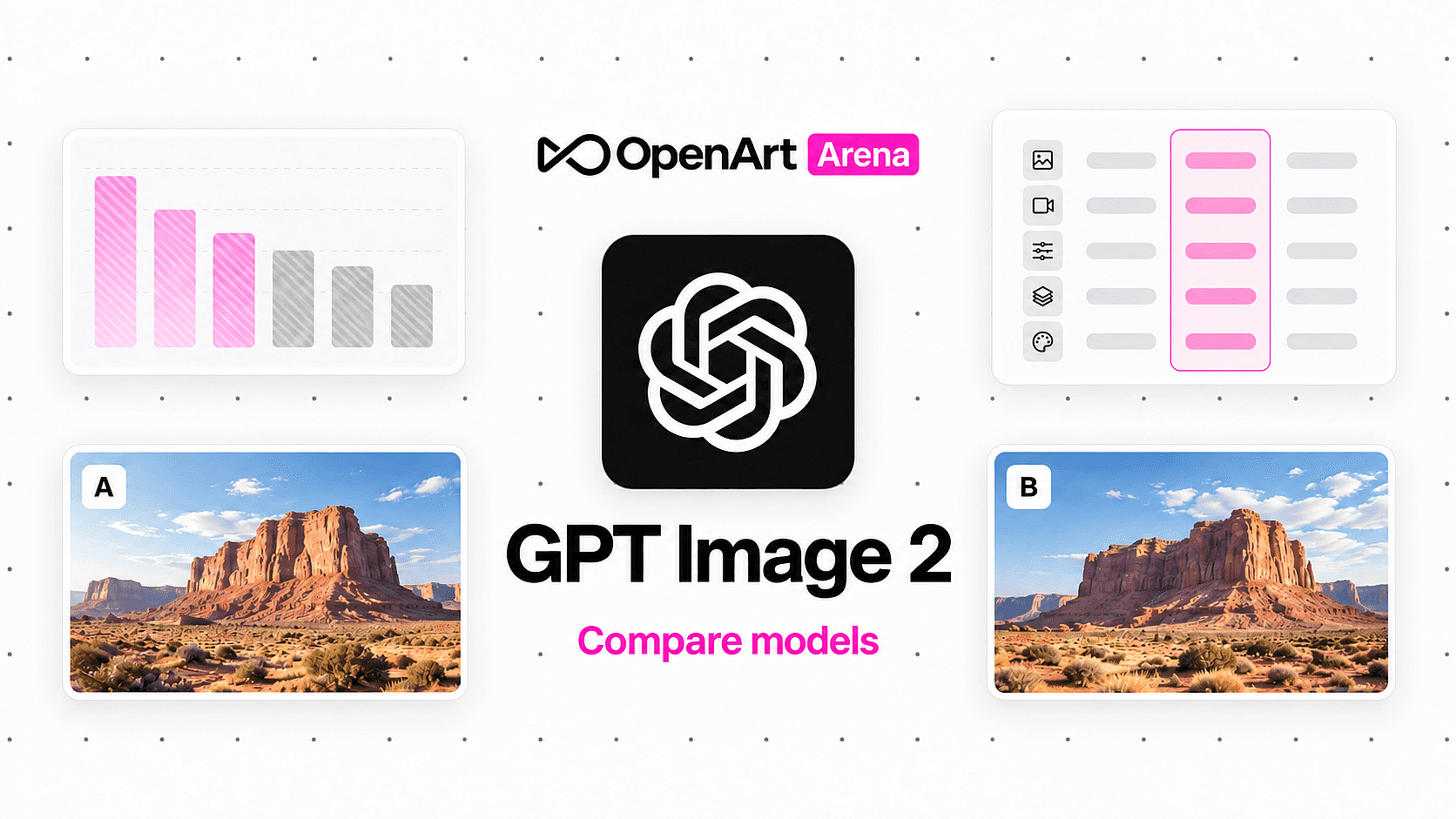
A campaign image has several jobs: show the product clearly, make the headline readable, and leave room for the offer. If you create ads for clients every week, model choice affects how much of that work needs fixing afterward.
This guide uses GPT Image 2's OpenArt Arena results to help you choose a model for your next brief. You can try GPT Image 2 with your own copy and reference images, or explore GPT Image 2.5. Test both with the same creative brief to see which delivers the text accuracy, visual style, and reference fidelity your project needs.
TL;DR
- GPT Image 2 places first in Graphic Design and Image Editing, second in Overall and E-commerce, and third in Film on the image boards below.
- Use the relevant task board to build your shortlist. An overall position does not answer every creative brief.
- Test the shortlisted models with the same copy, references, and output requirements. Judge the amount of correction needed before delivery.
Where does GPT Image 2 rank on OpenArt Arena?
The table records the v1.0 image leaderboard display checked on September 17, 2026, from OpenArt Arena. Rows follow the Overall order. Higher scores indicate stronger relative results within that column.
| Model | Overall | E-commerce | Film | Graphic Design | Image Editing |
|---|---|---|---|---|---|
| Seedream 5.0 Pro | 1051 | 1025 | 1074 | 975 | 1037 |
| GPT Image 2 | 1047 | 1023 | 1058 | 1051 | 1045 |
| Nano Banana Pro | 1008 | 1008 | 1059 | 952 | 1035 |
| Grok Imagine 2.0 | 1000 | 1000 | 1000 | 1000 | 1000 |
| Nano Banana 2 | 985 | 1014 | 998 | 952 | 1032 |
| Qwen Image 3.0 | 966 | 940 | 964 | 936 | 992 |
| Flux.2 Pro | 927 | 931 | 978 | 901 | 955 |
These are image results. The Film column evaluates still images, not video generation. Scores and positions can change as Arena updates.
How to read the scores
Arena uses blind comparisons: judges see paired outputs without model names and evaluate them against stated criteria. Its published methodology describes relative scores and 95% confidence intervals.
Compare scores within one board. A score of 1051 in Graphic Design is not equivalent to 1051 Overall, and a score gap is not a percentage improvement. Check confidence intervals before treating a small gap as decisive.
The task criteria explain why the boards matter. Graphic Design includes text, typography, and layout. E-commerce includes product realism and brand consistency. Image Editing includes adherence to edit instructions, precise editing, and style adaptation. Speed and cost are outside the quality scores. See the Arena evaluation methodology for the scoring details.
OpenArt operates Arena and provides access to models on its creation platform. The following workflows are our editorial suggestions, not additional benchmark tests.
Which model should you compare with GPT Image 2?
Seedream 5.0 Pro: start here for a product campaign
Seedream leads the displayed Overall and E-commerce boards. GPT Image 2 sits close behind on both, so a product brief is a useful place to compare them.
Use a real product reference you have permission to use. Ask both models for the same setting and crop. Compare the product silhouette, label, material, and relationship to nearby objects. A beautiful background cannot compensate for the wrong bottle shape.
If your campaign also needs a headline and offer, add them to the brief before testing. Otherwise, you will be choosing a model using a simpler task than the one you actually need to finish.
Nano Banana 2 and Nano Banana Pro: keep the versions separate
These are distinct entries in the table. Pro sits immediately above GPT Image 2 on Film; Nano Banana 2 is third on E-commerce.
For a product ad, compare GPT Image 2 and Nano Banana 2 using the same packaging reference and exact headline. For a cinematic campaign still, include Nano Banana Pro in your shortlist. Inspect lighting, facial details if present, and whether the scene leaves usable space for copy.
For a dedicated two-model discussion, read GPT Image 2 vs. Nano Banana 2.
Grok Imagine 2.0: add it to a layout comparison
Grok is the second entry on the displayed Graphic Design board. That makes it a relevant comparison for a poster or promotional graphic.
Give both models the same headline, supporting line, and call to action. Check reading order at phone size. Then inspect the full-size image for missing letters, unwanted text, and awkward spacing. Record which output needs less correction.
Put GPT Image 2 to work on a recurring campaign
Start with a deliverable you already understand: a weekly offer, a product launch graphic, or a revision to an approved concept. You will have a clearer standard for success than you would with an open-ended request for a beautiful image.
For a small agency handling several client accounts, three requirements are worth defining before generation:
- The copy that must appear exactly, including punctuation and prices.
- The product or brand details that must match the reference.
- The changes allowed between campaign variants.
These requirements help you compare models and review edits. Keep them with the brief so another teammate can judge the output against the same standard.
Create the first version in three steps
- Open the model. Go to GPT Image 2's creation page and confirm the selected model.
- Add the brief and references. Describe the composition, paste the exact copy, and upload the relevant reference image. Choose the aspect ratio and other available settings for your intended placement.
- Generate and review. Check the result against your requirements, then request a specific change. OpenArt's image generation walkthrough explains the wider workflow.
For paid client work, check your plan's commercial-use terms as well as the generation cost on the OpenArt pricing page. Arena scores do not include either.
Copy this brief for a coffee campaign
This is an original practice prompt for a fictional brand, not an Arena test case or a claimed model output. Use the matching aspect-ratio setting when generating.
Create a 4:5 social ad concept for a fictional coffee brand called NORTH COAST.

Show one matte cream coffee bag on a pale blue tabletop. Use soft morning
light from the left and a simple studio background. The bag should occupy
the lower half of the image. Keep the upper third clear for a headline.

Use dark navy typography with this exact copy:
Headline: "A slower start. A better coffee."
Supporting line: "Meet your morning blend."
Button text: "Explore the blend"

The headline should be the first thing a viewer reads. Keep the supporting
line smaller. Place the button near the bottom with clear space around it.
Show only "NORTH COAST" on the bag. Add no extra words, badges, or objects.
For client work, replace the fictional brand and add an approved product reference. Specify which visible details must remain unchanged.
Once you have a version worth refining, try a narrow edit:
Change only the background from pale blue to warm ivory. Keep the bag,
all wording, typography, layout, and crop unchanged.
Treat the second prompt as a request to verify. Compare the edited image with the original, especially the lettering and product edges.
Check the details that decide whether an image is usable
A creator working on watch advertising described struggling to preserve tiny dial text while using AI image tools. The product-fidelity discussion is one person's experience, not a controlled model comparison. It illustrates a useful acceptance test: small brand details can decide whether an otherwise convincing image is deliverable.
Before choosing between outputs, use this review sheet:
| Check | What to inspect | Reason to revise |
|---|---|---|
| Copy | Every letter, number, and punctuation mark | The offer or brand name has changed |
| Product | Shape, color, material, and visible label | The image depicts a different product |
| Layout | Reading order and crop at the intended display size | The headline or call to action is hard to read |
| Edit | Areas outside the requested change | An approved detail has moved or changed |
For a fair practical comparison, give each model the same number of attempts. Keep the reference, brief, and output size as consistent as the settings allow. Count corrections across all attempts, rather than selecting one lucky result and ignoring the rest.
This small exercise tells you something a leaderboard cannot: which model makes your particular recurring assignment easier to finish.
Frequently asked questions
Is GPT Image 2 the best model for every image task?
Choose by the task board, then test your brief. A campaign that depends on exact packaging details needs a different review from a mood image with no text. Use the table as a shortlist, not an automatic approval of the output.
Can I use GPT Image 2 on OpenArt without an API key?
Yes. OpenArt provides a browser interface for prompting and generating images with the model. You do not need to build an API integration to follow this guide.
How do I get more useful text and layout results?
Specify the exact wording and where each text element belongs. Start with a short headline and a clear reading order. Check every generated version; an instruction to preserve text does not guarantee that all letters remain correct.
Does a high editing score guarantee an unchanged logo?
No. Check the actual output against the source artwork. If an exact logo is a delivery requirement, preserve the approved artwork for final placement rather than assuming a generated version is identical.
How should I compare GPT Image 2 with Nano Banana 2?
Use a brief that reflects the work you repeat, such as a product ad with a fixed headline. Keep the inputs consistent, review several outputs, and track which model requires fewer corrections to satisfy that brief.